National Symphony Orchestra Cuts Season After Kennedy Center Closes
The 95-year-old ensemble will perform in six temporary venues this year while ticket revenue drops by half and the institution fights for stability.
By Maya Morris ·
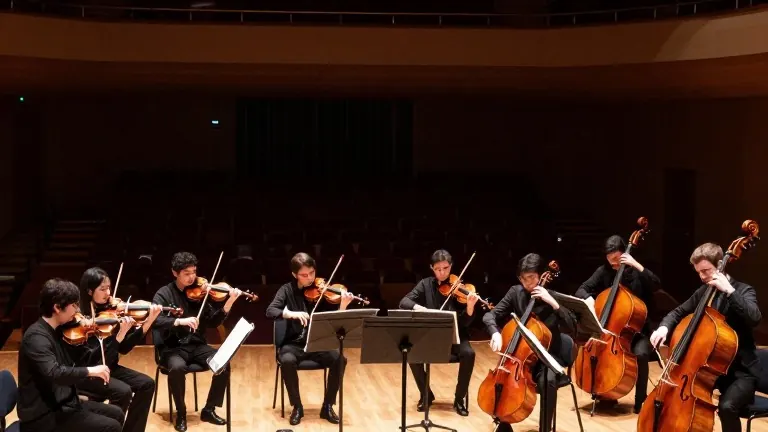
The National Symphony Orchestra opened its new season on September 26 in Bethesda, Maryland, more than ten miles from its longtime home. The 95-year-old ensemble performed at the Music Center at Strathmore because the John F. Kennedy Center for the Performing Arts in Washington, D.C., closed its doors on September 15. The closure followed a period of declining ticket sales, audience boycotts, and a federal court dispute over President Donald Trump’s name appearing on the building’s exterior.
Trump assumed control of the Kennedy Center in early 2025. He removed several board members and fired the center’s president, Deborah Rutter. The National Symphony Orchestra has performed in the complex since it opened in 1971. Music director Gianandrea Noseda, who has led the group for nine years, described the sudden change as a cold shower. He stated that the immediate reaction among the musicians was to wonder what they would do without a permanent home.
The orchestra quickly secured six alternative venues in the greater Washington area. It hoped to keep a portion of its budget intact while the legal and political conflicts continued. Anne Midgette, a former classical music critic for The Washington Post, said she feared the orchestra might not have a season at all. She noted that the National Symphony Orchestra is deeply tied to the identity of the Kennedy Center.
The new season was announced in mid-August, only six weeks before the opening concert. Most symphonies release their schedules in early spring. The delayed announcement occurred because the orchestra waited for budget approval from the Kennedy Center Board of Trustees. The opening program featured new work by Carlos Simon alongside pieces by Tchaikovsky and Respighi. Midgette described the evening as bittersweet, noting the joy of seeing the musicians together while lamenting that a major city orchestra had to perform outside its primary hall.
The financial impact is severe. The Washington Post reported in August that ticket revenue is expected to fall by about half. Donations are projected to drop by a quarter. These cuts are partly due to reductions in the Kennedy Center’s development department. The orchestra also lost most of its former staff. Jean Davidson, the former executive director, left her position in March, citing the turmoil at the center as the primary reason for her departure.
Rick Barber, the associate principal double bassist who joined the group in 1995, said the musicians were stunned by the closure. He described the following months as a period of anxiety but did not believe the orchestra would fold. Barber said that while political divisions are visible in daily life, they disappear when he is playing. Noseda remains optimistic, stating that the goal is to reach new audiences in different locations. He extended his contract with the orchestra through 2031 rather than seeking a new position.
The season will include about half the number of concerts usually programmed. Midgette called the season an acid test for audience interest. She pointed to national trends where symphonies are struggling financially and some are closing, citing the Phoenix Symphony as a recent example. She noted that rising costs for transportation and living make it harder for families to afford concert tickets. Noseda believes the music can still bring people together, even during challenging times.
Source: WEPR