Adif Halts Madrid to Seville Line After Collision Kills 10
A rear-end crash in Toledo province derailed carriages, prompting officials to prepare local facilities for injured survivors ahead of next month's election.
By Maya Morris ·
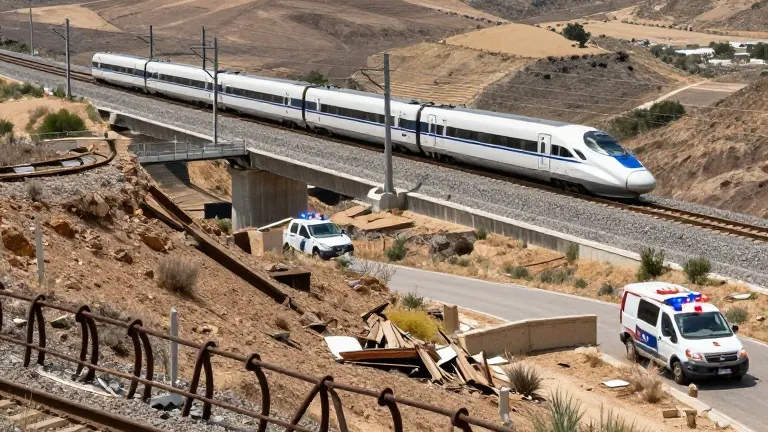
Ten people died when two high-speed trains collided in Toledo province on Wednesday morning, according to regional officials in Castilla-La Mancha.
Esther Padilla, a spokesperson for the regional government, told local media that authorities had confirmed the ten fatalities. She warned that the death toll could rise. "The information we are receiving is not good at all," Padilla said.
Spain's state rail infrastructure authority, Adif, suspended all services between Madrid and the southern region of Andalucía following the accident. The agency described the incident as a rear-end collision on the line connecting Madrid and Seville.
State broadcaster TVE reported that a moving train struck the rear of a stopped service. The impact pushed two carriages off the track. Footage from Castilla La Mancha Television showed one derailed carriage still resting on an elevated section of track. Debris, including twisted metal and broken panels, scattered across the embankment below the rail line.
Government sources told El País that the severity of the crash could exceed the January Adamuz disaster, which claimed 46 lives. Manuel Galán, the mayor of Urda near Toledo, said emergency services requested a local sports hall to accommodate the injured.
The crash occurred while Spain's major political parties prepared for a general election next month. Both leading parties suspended their planned campaign activities for the day.
Prime Minister Pedro Sánchez posted on X that he remained in constant contact with the transport minister and the president of Castilla-La Mancha. He offered support to victims and their families. Alberto Núñez Feijóo, leader of the opposition People's party, also posted on X. He stated that attending to victims was the top priority and pledged support to the emergency teams on the ground.
Source: The Guardian