Study finds LA fire smoke contained lead levels 80 times above background
Caltech researchers say the 2025 Eaton Fire plume exposed 7 million residents to toxic heavy metals far exceeding typical urban air quality.
By Nicholas James ·
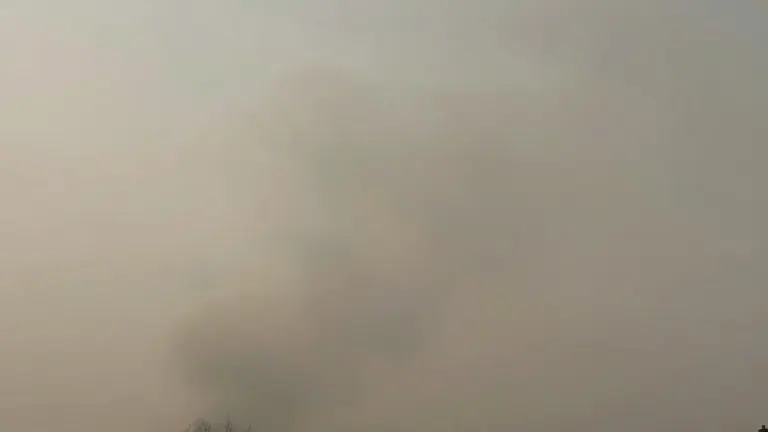
The Eaton Fire in Los Angeles released a smoke plume distinct from typical wildfires, containing heavy metals at levels that exposed millions of residents to acute toxic risk in 2025.
A study published Wednesday in the journal Science Advances reveals that the chemical makeup of the urban fire differed sharply from wildland fires. Researchers from the California Institute of Technology analyzed data from the Atmospheric Science and Chemistry mEasurement NeTwork, or ASCENT, to track particulate composition in real time.
The findings indicate that the smoke from the Eaton Fire contained 50 times more lead, three times more arsenic, and seven times more halogens than smoke from a 2024 wildfire in Riverside County that primarily burned vegetation.
At the peak of the burning, approximately 7 million people in Los Angeles were exposed to lead levels more than 80 times the typical background concentration for a 24-hour period.
Nga Lee “Sally” Ng, an author of the study, stated that the core finding is that wildfire smoke is fundamentally different from urban smoke. She noted that the new measurement technology allowed researchers to see the detailed components of particles that residents were breathing.
Haroula Baliaka, a co-author, explained that understanding these chemical differences bridges a gap in research. As climate change drives drier and warmer weather, wildfires are becoming larger and more frequent. The growth of urban areas is pushing these fires into cities, requiring adjustments in monitoring and emergency response.
The two fires that ignited on Jan. 7, 2025, in Altadena and the Pacific Palisades killed at least 31 people and destroyed more than 16,000 structures. The flames consumed homes, vehicles, paint, furniture, and chemicals, releasing toxic substances into the air.
Ed Avol, a professor emeritus at the University of Southern California who was not involved in the study, said the high exposure to heavy metals was consistent with his expectations but surprising because it had not been previously documented. He highlighted the advantage of the hour-by-hour measurements taken by the ASCENT network, which contrasts with the typical schedule of measuring airborne particulates only a couple of times a week.
Yaguang Wei, an assistant professor at Mount Sinai, noted that the findings reinforce previous conclusions that wildfire smoke is more toxic than particulates from other sources. He pointed out that burning properties releases lead from wall paint, as well as toxic plastics and electronics.
Wei suggested that the study has important policy implications, advocating for stronger government actions such as increased wildfire monitoring, public alerts, and prescribed fires. Avol added that the research serves as a reminder to minimize exposure to metals and halogens in urban environments.
Source: WCCB