Barnes Ice Cap Reversed Course After Glaciation Began, Study Finds
Researchers date the ice cap's expansion and abrupt retreat around 1960, concluding humans halted an ice age in its early stages.
By Maya Morris ·
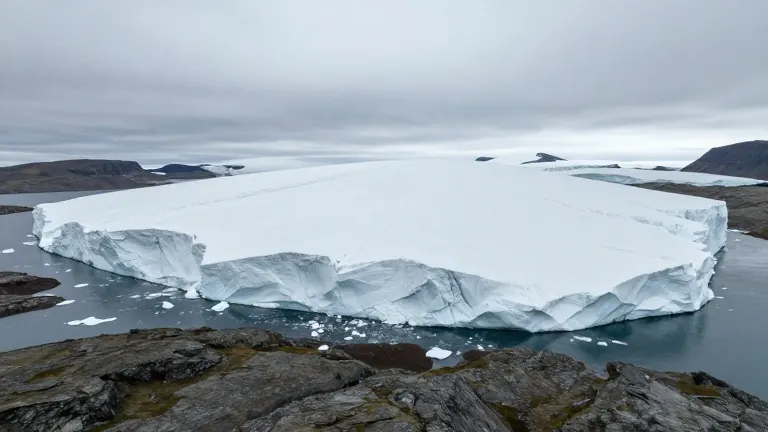
Nicolás Young and a team of scientists studying a Delaware-sized ice cap on Baffin Island report that the Barnes Ice Cap began growing about 2,000 years ago, then reversed course and started shrinking around 1960. The study was published in the journal Science.
The Barnes Ice Cap is all that remains of the Laurentide Ice Sheet, which extended from the Arctic Circle to Illinois and reached thicknesses of two miles about 20,000 years ago. The ice sheet reached its minimum extent roughly 3,000 years ago and began to regrow in response to cooler temperatures about 2,000 years ago, the researchers found.
The team gathered long-dead mosses near the ice cap's edge to date when they were last alive, and tested rocks for a rare radioactive isotope that accumulates once stone is exposed to air. Because the Barnes Ice Cap is frozen to bedrock and does not slide, it has preserved the plants entombed within it as it advanced.
Young, a geochemist at the Lamont-Doherty Earth Observatory at the Columbia Climate School, said the regrowth marked the start of a new glaciation that stopped before it progressed further. "It was just getting started, everything was normal, the next glaciation was about to happen, and yet it stopped," Young said. He added that greenhouse gas emissions have "essentially overpowered" natural mechanisms that cool the region.
Meredith Kelly, an earth sciences professor at Dartmouth College who did not participate in the study, said the research applies "novel radiocarbon dating of plants" to establish the ice cap's advance and retreat. Kelly said the conclusion that the advance marks the start of an ice age could be correct, but that comparing the Barnes Ice Cap with glaciers in other regions advancing at the same time would clarify the mechanisms involved.
Andrey Ganopolski, a physicist at the Potsdam Institute for Climate Impact Research, said modeling studies including his own indicate the next ice age would not be expected for another 50,000 years without global warming. He said the Barnes Ice Cap's growth "is insufficient to support the conclusion that a new glacial cycle had already begun and was subsequently aborted."
Young and his co-authors maintain that the first regrowth of the Laurentide Ice Sheet constitutes the start of an ice age, without waiting for the formation of enormous ice sheets. Young said the findings also bear on the 1970s debate over a possible coming ice age, including a Newsweek article headlined "The Cooling World" that warned of a food crisis as temperatures fell.
Young cautioned that the study should not be read as showing global warming has "saved humanity from an ice age." Glaciation operates over long time frames, and thousands of years would have passed before the ice cap reached a size affecting daily life, he said.
Source: CNN