Florida Governor-Elect Misleads on Oil Flow
Byron Donalds claimed more oil now transits the Strait of Hormuz than before the Iran war, a statement PolitiFact rated Mostly False.
By Nicholas James ·
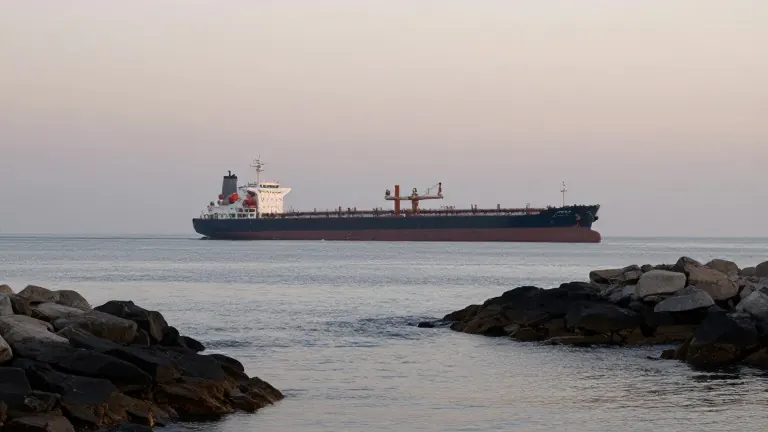
Florida Governor-elect Byron Donalds suggested on national television that current oil traffic in the Persian Gulf exceeds pre-war levels, a claim that simplifies complex shipping data.
In a November 8 interview on NBC’s “Meet the Press,” Donalds responded to host Kristen Welker, who played a clip of current Governor Ron DeSantis criticizing Republicans for blaming high gas prices on former President Joe Biden instead of the Iran war.
Donalds disputed that blame game. He cited a Wall Street Journal article, stating that insurance costs for shipping through the Strait of Hormuz had risen substantially while more oil moved through the strait than there was pre-war.
The Journal story, dated October 20, reported that overall Middle East oil flows, which include the strait and alternative routes, averaged more than 24 million barrels a day during the week ending October 18.
That total surpassed pre-war levels of 23.3 million barrels a day, according to ship tracker Kpler. However, the same article noted that flows specifically through the Strait of Hormuz averaged around 14 million barrels a day, or 82% of pre-war levels.
Skip York, an energy and global oil fellow at Rice University’s Center for Energy Studies, explained that while some days in October saw over 20 million barrels move through the Gulf region, the flow was not consistently exceeding pre-conflict levels.
York noted in an email that traffic increased even as Iranian drone and missile attacks ramped up in mid-October. Approximately half of all vessels hit since the conflict began in March were struck in that single month.
Clark Williams-Derry, an energy finance analyst at the Institute for Energy Economics and Financial Analysis, described the situation as driven by profit rather than security.
Charterers are paying daily freight rates of around $1 million a day to move oil from the Gulf to international markets like Asia, where prices are higher. Williams-Derry stated that moving a million barrels through the strait can generate tens of millions of dollars in profit.
Vortexa, a data analytics company, estimated that 9.2 million barrels of oil passed through the Strait of Hormuz alone during the week ending October 18. The following week, that figure dropped to 15.1 million barrels for the entire Gulf region, and 17.1 million barrels the week after.
Reuters reported on November 3 that Gulf oil exports dipped in October compared to September, when exports were the highest since the war started. Vortexa found that Middle East flows averaged 17.1 million barrels per day in October, down from 18.9 million in September.
PolitiFact rated Donalds’ statement Mostly False. While regional flows occasionally matched pre-war peaks, the average amount of oil passing through the strait itself remains below pre-war levels, and shipping remains dangerous.